
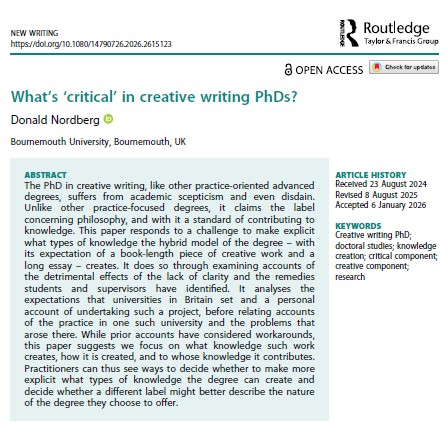
What’s a PhD in creative writing? What knowledge does it create?
In the novel Hard Times, Charles Dickens presents a retired hardware merchant, Mr. Thomas Gradgrind, as a rationalist and disarmingly naïve utilitarian. He seeks to banish emotion from all decision-making and has tried to raise his five children to do the same, naming each after prominent utilitarians. The list of characters in my edition[1] labels his youngest son – his namesake, Thomas without the “Mr.” – as “a selfish, ill-natured whelp.” The opening chapter starts with Mr. Gradgrind haranguing a schoolmaster:
“Now, what I want is Facts. Teach these boys and girls nothing but Facts. Facts alone are wanted in life. Plant nothing else, and root out everything else. You can only form the minds of reasoning animals upon Facts: nothing else will ever be of any service to them. This is the principle on which I bring up my own children, and this is the principle on which I bring up these children. Stick to Facts, sir!”
The philosopher Martha Nussbaum uses this novel and a few others, as well as the poetry of Walt Whitman, to address a question I puzzle over almost every day. Why do we bother with fiction?
Read more at

A famous aphorism about life in general draws its analogy from books:
You can’t judge a book by its cover
It’s a warning against leaping to a conclusion, or judging people or things by their appearance. It reminds us that beauty is more than skin deep, and that two swallows don’t make a summer.
There’s much empirical evidence in the book trade, however, that – like it or not – the cover of a book sells the story, even if it doesn’t tell it.
And this: We also know that artificial intelligence is worming its way into all our lives. Here’s a tale of cover creation, from first-hand experience.
Many of the writers I know moan about covers and publishers. Rarely does an author – other than a completely self-published one – have editorial control over the cover design. Big publishers have professional design crews, who often seem to bully writers. Many independent publishers use templates that permit only small modifications of art and typeface.
Living up to the aphorism, such formulas of cover design point to something generic, to which genre the book adheres. The cover is a tool of categorization, a typecasting, not a description of the individual distinctiveness of a piece of writing.
But what happens if we throw artificial intelligence into the mix – as a cost saving tool and to break the stranglehold of templates and categories? Having just been through the process with my novel, The Fleetwood Half-Orphan Asylum, here’s an account of what transpired and what it inspired. …
Read more at
By Donald Nordberg, manuscript accepted and published in 2024: New Writing 21(1), 73-93. doi: 10.1080/14790726.2023.2222098
Abstract: Philosophically engaged fiction often employs ideas in ways that reflect the exploitation-exploration dilemma in developmental psychology: by exploiting well articulated theories by enacting their conflicts, or by exploring the uncertainties of puzzling ontologies or moral complexities. We can see this in action in many works, but some novels of ideas seek to defy such categorization, with lessons for readers and writers. This paper analyzes two recent works – The Overstory by Richard Powers (2018) and Elizabeth McKenzie’s The Portable Veblen (2016) – to show how they deal with related concerns and settings through very different approaches. While Powers offers an enactment, its complexity seeks to evade the book becoming a simple polemic. McKenzie’s protagonist explores her muddled identity, philosophy and much else while flirting with the enactment of ideas when she does not comprehend.
Read more at
By Donald Nordberg, manuscript of a paper published in Philosophy and Literature (2023), Vol. 47, Issue 1, pp. 108-127; doi:10.1353/phl.2023.a899681; © Johns Hopkins University Press, please cite published version
Abstract. I examine the often-denigrated concept of the novel of ideas from its inception and critical decline to its relatively recent revival. Using a variant of the exploitation-exploration dilemma in psychology, I suggest that early usage referred to works that exploit philosophical principles—or better, enact them—by setting philosophical positions in conflict. By contrast, use of the concept for more recent works sees characters and plots exploring philosophical stances. The shift corresponds with the greater attention paid to complexity and ambiguity that are hallmarks of continental philosophy and neopragmatism, and with it greater need to explore philosophical stances through fiction.
Read more at
By Donald Nordberg, manuscript accepted for publication in 2021 at New Writing (Routledge, https://doi.org/10.1080/14790726.2020.1855200)
Abstract: Would-be writers of fiction face choices as soon as they start thinking about how to get published: What sort of a work is this? Where will the book sit on the shelf? What does the publisher tell the reader about what to expect? And then, where does it sit in company of other works, and where do you sit in the company of other writers? This paper examines three such questions of category choice: plot versus character, genre versus literary, psychology versus philosophy. It asks how do writers – and audiences – make sense of a work of fiction, and with what implications for the process of writing? It suggests how writers might use the differences between them to enhance the experience of reading beyond the expectations set by the categories to which the works have been placed.
Read more at
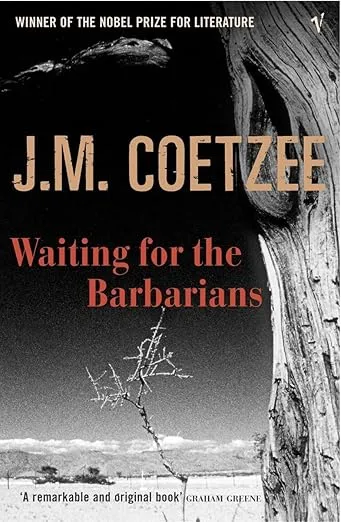
I didn’t read J. M. Coetzee’s fiction until about five years ago. I had read his half of an exchange of letters with Paul Auster, a Christmas present from my son, who knew about my interest Auster’s writing. My son thought I might be interested in what Auster wrote when he wasn’t consciously concocting something a step or two outside normal human existence, but close enough that it felt, well, right.
The fiction of Coetzee – who won the Nobel Prize for Literature in 2003 – came into my purview in 2019. The accidental combinati on of a chat with a scholar of English literature and mentions in newspaper articles about his fiction alerted me to Coetzee’s link to philosophical inquiry. I then read three of his books – The Life and Times of Michael K. (1983), Diary of a Bad Year (2007), and Elisabeth Costello (2001). Now this:
Waiting for the Barbarians (1980) is even more unsettling than the others …
Read the rest of Coetzee is waiting for meaning … on Substack.

One evening, and for no particular reason – an absence of anything fresh-sounding in the streaming services, perhaps? – we dipped into an unlikely looking thriller series: “Atomic,” produced for Sky Studios. At least it was something we hadn’t dipped into before and rejected. It promised a story of drug smuggler in North Africa who meets a jihadi.
Soon I found myself asking a question: What turns the unlikely, implausible and frankly repugnant into something that’s, well, fun – sort of? How do the writers, or the director, or the actors pull this off? …
Read the rest of ‘Atomic’ – the ironic likability of a jihadi and a drug smuggler on Substack.
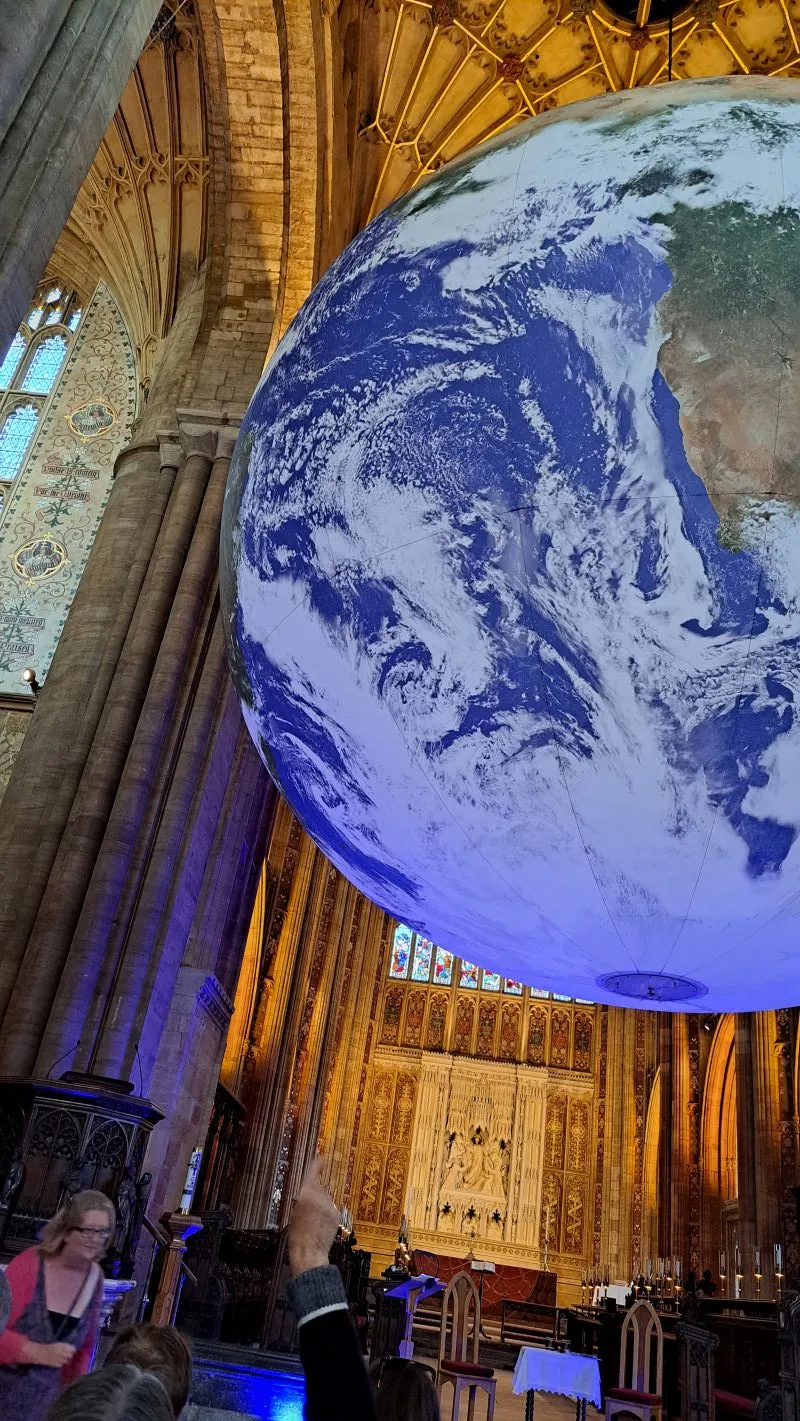
A few weeks back, Samantha Harvey came to talk in the splendid church of Sherborne Abbey about her splendid, little, and 2024 Booker Prize-winning novel Orbital.
I discussed the book in these pages shortly before it won the prize, how it winds its plotless story around us readers much as its inaction winds the international space station sixteen times around the Earth during twenty-four hours of flight.
Harvey’s visit to Sherborne came as the Abbey was hosting an exhibition of “Gaia,” including a giant globe suspended and rotating from the vaulting heights of the church, a setting that added perspective to the novel’s content, in which the space station itself feels like a metaphor for Earth itself.
I won’t repeat the substance of the book or my review, but I was intrigued by the answer Harvey gave to question from a member of the 300-odd people who filled the nave of the church. …
Read the rest of What makes a plotless novel work? (Orbital, coming around again) on Substack.
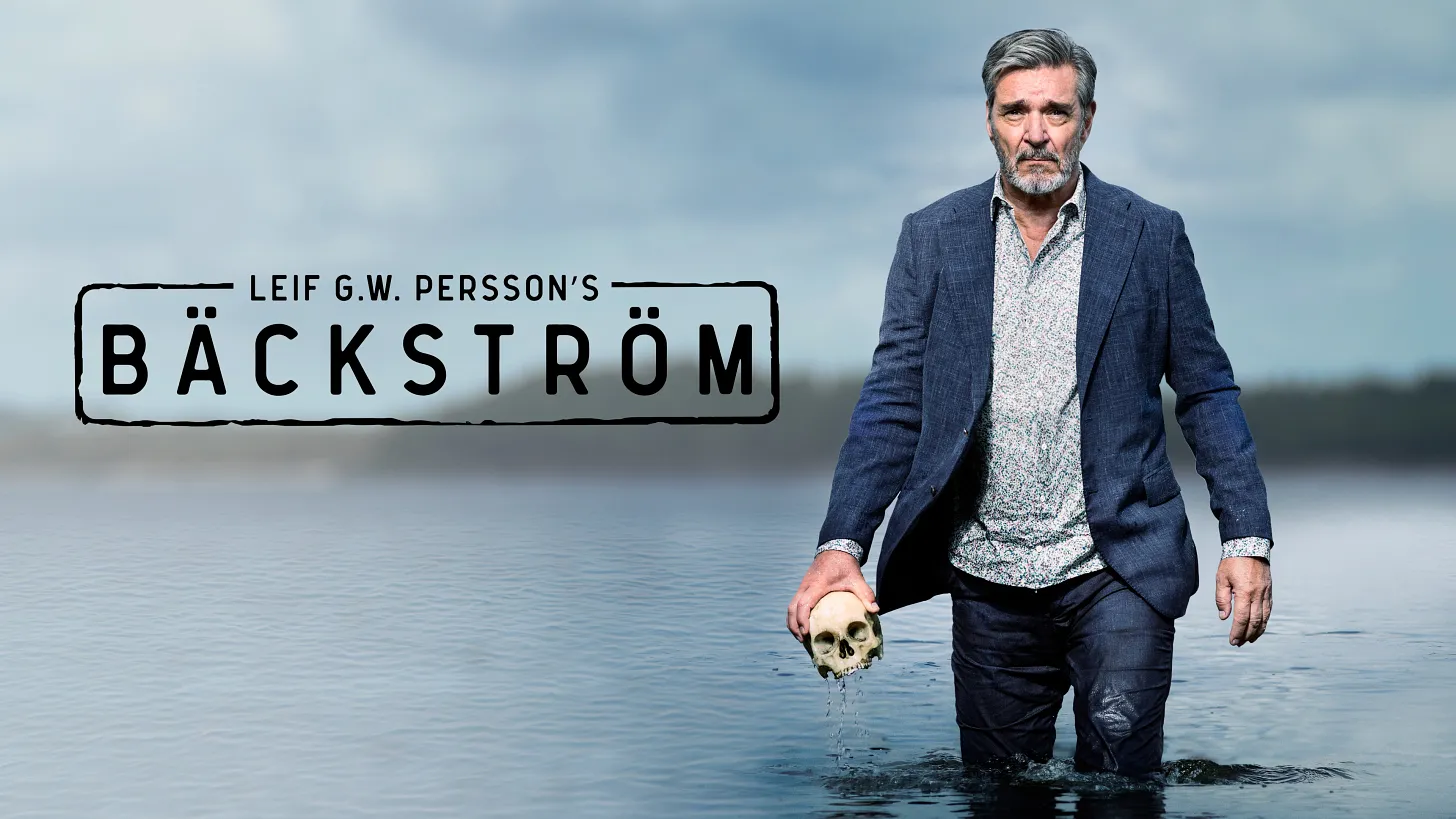
Evert Bäckström is the cleverest cop in the Stockholm police force, having cleared up 99 percent of the murder cases he’s ever investigated during his long career. That record has won the grizzled, bedraggled detective a regular slot as a commentator on a popular television crime-chat show, where he runs circles around his opposite number, a defense attorney who’s now almost as famous as Bäckström himself. It makes Bäckström untouchable, even by his skeptical bosses. The supporting evidence:
Welcome to world of the lovable, hate-able Bäckström, which first aired on Swedish television in 2020. It’s based on the novels of Leif G. W. Persson. …
Read the rest of The backflips of ‘Bäckström’ – Don Nordberg (is/on) writing on Substack.