
What is the point of fiction?
- Some storytelling has a simple declared intention: to entertain. That’s it.
- Others are educative. They are often didactic, with a moral, like a lesson in a children’s book separating good from evil with a smile, or stories warning about a warming climate told by building readers’ empathy with characters confronting capitalism, rather than presenting scientific evidence. They are ones that enact a fixed set of ideas through narrative. They educate by entertaining. They run the risk of letting ideas tip into ideologies.
- Others explore ideas that aren’t yet fixed, at least not in the mind of the fiction writer, but with the aim of finding some truth (Nordberg, 2023, 2024).
Every so often – and they come less often than I as reader would like – some pursue ideas without an ulterior motive, an end for which fiction is the means. These observe and inform.
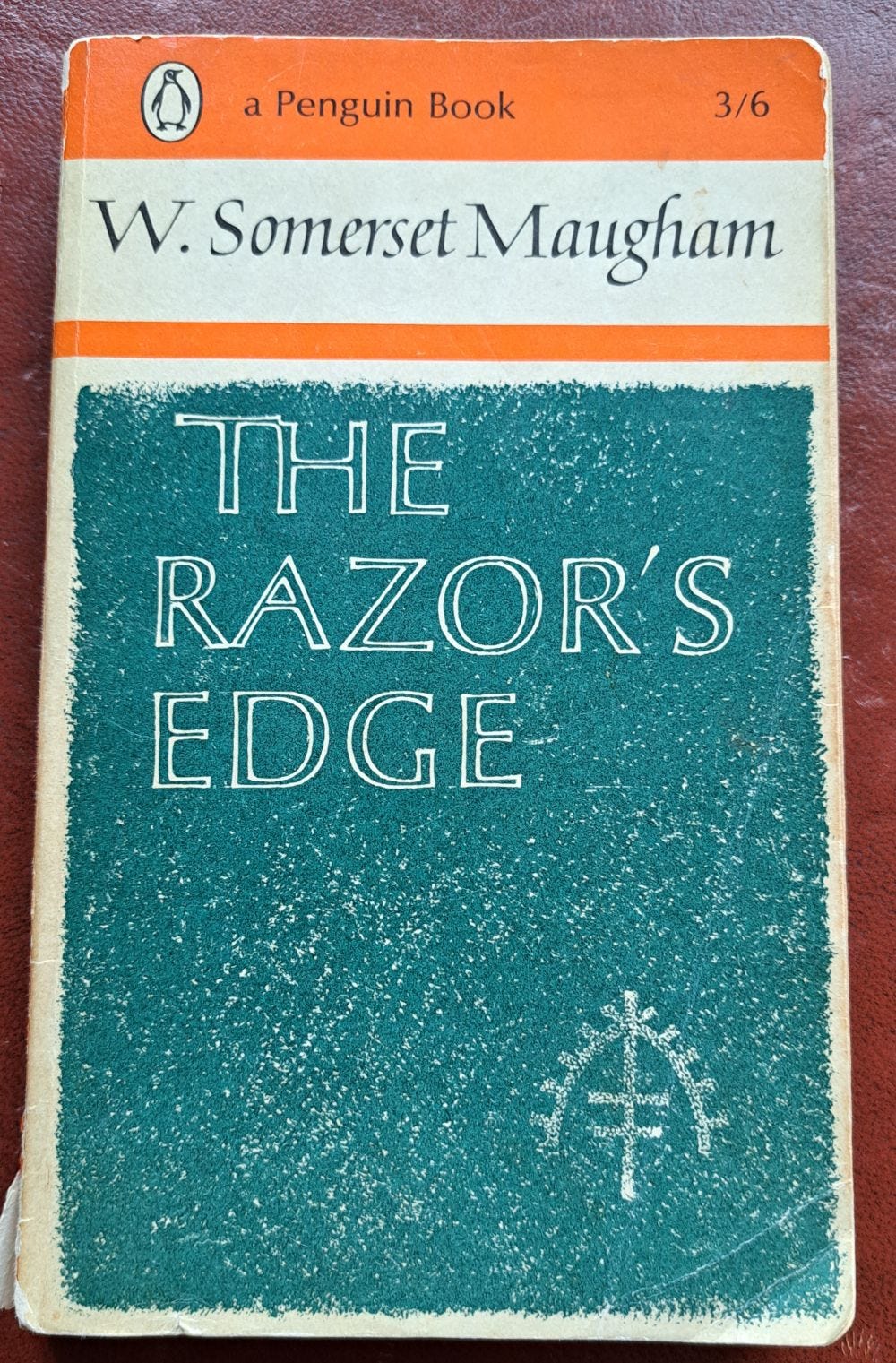
I’ve just read one of these, one that builds a sense of satisfaction, of openness and tolerance, despite the insignificance of its plot, its modest claims of analysis, and its absence of moralizing. The work: The Razor’s Edge, a somewhat quaint and rather quiet 1944 novel by William Somerset Maugham.
It came to my attention a couple of years ago, when a professional editor mentioned its unusual and striking method of narration. Look it up, she said. I finally have. …
Read the rest of Novelist as observer: Somerset Maugham and The Razor’s Edge on Substack.

